Peter Rudolph b. 1946
-
 Sky High, 2026
 -
Sunflowers and Squash Blossoms, 2026 Sold
-
Backyard 1, 2026
-
Backyard 2, 2026
-
Backyard 3, 2026
-
Backyard 4, 2026
-
Backyard 5, 2026
-
Last Silhouettes, 2025
-
Raking Shadows
-
August Sun, 2026
-
Backyard 6, 2026
-
Seven O'clock Blues, 2026 Sold
-
Poppies 1, 2025
-
Poppies 2, 2025
-
Poppies 3, 2026
-
Violet Sunset, 2026
-
Late Afternoon, 2025-26
-
Poppies, 2024
-
Field of Poppies, 2024
-
Passing Cloud, 2025
-
Midsummer Sunflowers, 2025
-
Full Sun Variation, 2024
-
Étude en Bleu, 2023
-
Blue Flags, 2022
-
Full Sun, 2023
-
Islesford Flowers, 2023
-
Untitled (A Glimpse of the Atlantic), 2025
-
Poppies, 2024 Sold






In the Paint: Peter Rudolph
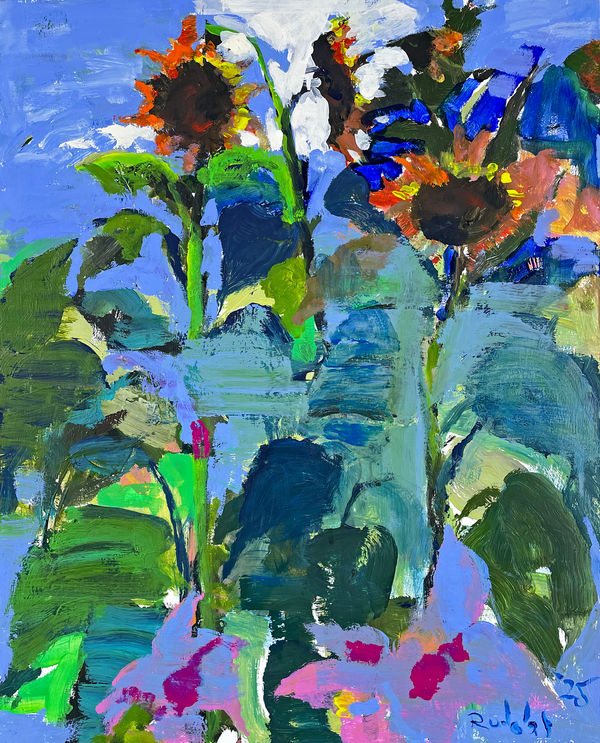
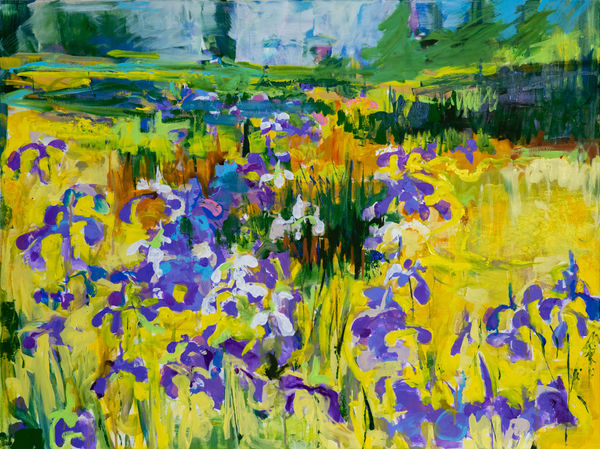
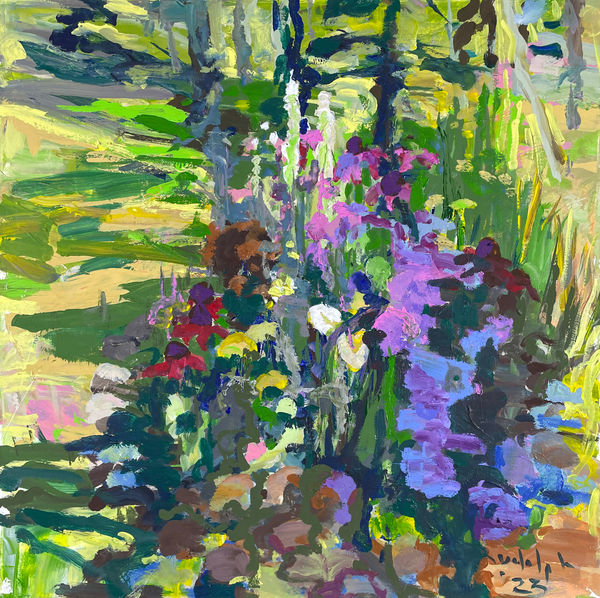
The act of looking, actually seeing, is at the heart of Peter Rudolph's artistic practice. He paints the landscape en plein air, but the goal is not to transcribe nature in painted form. His objective is to see his subject from a distance and then capture some evocation of it in paint. "This isn't about painting pretty flowers," says Rudolph. "I don't think like that. I paint these things from nature. I set up there and I have a look at it, but I'm not painting what I'm looking at."
In From the Backyard, Maine, his latest of body of work, Rudolph uses the landscape and flowers in his summer backyard in Isleford as the starting point in his exploration of looking. Through brilliant color, robust brushwork, and energetic abstraction, Rudolph conjures what he sees into complex compositions that reference the natural world but never record it. His subjects become expansive, bigger than the known world they refer to. "The whole idea with painting these flowers," he says, "is that they are colors first and then flowers next." The subjects are indeed secondary to the form. Some are recognizable, some are total abstractions, some hover between the two, but Rudolph always manages to get to the essence of what he's looking at. He doesn't get mired in the details. His paintings are neither precious nor tame. They are riots of color, brilliant evocations of Maine in all its beauty and wildness.
Rudolph initially studied fine art at Syracuse University. His parents divorced when he was young and he spent his summers with his father, who was an architect, in East Hampton. The year Rudolph turned twenty in 1966, his father told him to get a job, so he went to Willem de Kooning's studio in nearby Springs, and asked the artist if he needed help. De Kooning agreed and Rudolph was a studio assistant and go-fer for the summer. "I cleaned brushes, moved art, put things together," Rudolph said. "He [de Kooning] would work in spurts. He would work and then not work. A lot of times, I'd show up in the morning and there'd be this whole painting there. So, he would paint when nobody else was around." On one of their excursions, Rudolph recalls: "He [de Kooning] took me to Louse Point. I drove him there, and he said, 'This is what I'm trying to do this summer. You see this figure across the way,' and you could barely see it, a little kid or something. And he said, 'I'm trying to paint that figure over there and bring it right in front of my face. I try to paint that figure and bring it here, bring it up here.'" That concept of spatial interplay became a core element of Rudolph's work.
The following year in 1967, Rudolph spent the year in Rome and intently studied the work of Alberto Giacometti. Rudolph understood a similarity between Giacometti and de Kooning. If de Kooning was trying to paint something far away up close, Giacometti was sculpting forms in the distance and leaving them there. Rudolph became enthralled by the push-pull between up close and far away. He conceptually linked it to the frisson between being and nothing -- the space between here and there, existing and not.
Rudolph continued to explore his interest in the vast concept of nothingness while he was a graduate student at the University of Pennsylvania in the 1970s. There he studied with Alex Katz, who he said "was just unbelievable" as a teacher. Katz was "visually intelligent, quick witted and had a great sense of humor." The two of them talked a lot about painting and style. Rudolph said: "I was never involved in anybody else's style. As a contemporary painter there were a lot of no nos -- no linear perspective, no atmospheric perspective, no School of Paris, no Cubism." During this period, he was largely a conceptual painter and embarked on a series of large 9 x 9 foot square abstract black paintings in attempt to depict nothing. "I was trying to paint nothing," Rudolph says. "Just nothingness… but I couldn't paint nothing because nothing when I painted it became something." Rudolph continued with this exploration of existentialism until it all came to a "grinding halt." "Why?" he asks, "because the real world. That's another thing de Kooning said. He said, 'you see this painting…I'm trying to catch this effect, but the real world comes in … it all sounds great … but then you have to deal with the real world.'"
The real world for Rudolph was the Vietnam War, two small children, making a living. His engagement with painting evolved and he became a teacher and painting restorer, particularly of historic American art. He now paints for himself during summers in Maine, but he matter-of-factly says, "every day I'm in the paint." Depending on the day, he may be working as a contemporary artist or a fine-art restorer, yet, regardless of where and why, he's always "in the paint," which is both a reality and a mantra.
In his more recent work, Rudolph continues to explore the themes that were formative for him as young artist. With the black paintings of the 1970s, he said he hit a "dead end" and had to "change the channel," but he's still interested in the tension between here and there, absence and presence. His visual language has changed, and the paintings are now more about the distance between representation and abstraction. Rudolph describes painting the space between the two: "I think of them [the paintings] a lot of times as like series of accidents…this little stroke here and there, and … this little stroke looks like a mistake, but that looks like a mistake too, and then you get them all together, and it adds up to this thing. That's … the space between [what I see and what I paint]. I make them, they are representational, but they aren't."
The paintings in From the Backyard bring Rudolph's artistic vision and intentional exploration of depth into clear focus. Each of them demonstrates Rudolph's unmatched painting style and way of seeing. "If I'm not working from nature, I feel like it's a lie… If I'm not looking at it, I'm thinking about it, then I go down a rabbit hole. I get lost. The paint gets heavy and thick and things don't work. The painting gets labored and stylized…and you know, there is nothing worse than stylization." There is nothing stylized about any of the paintings in From the Backyard. Indeed, what makes them exceptional is their immediacy and Rudolph's unique ability to paint color and form above all else. Their lack of specificity makes them elemental. They are paintings of places in nature that are more about the looking itself. When viewed as a group, it's as if the viewer is Rudolph himself in the middle of his backyard garden, taking in all there is to see and reflecting it back in the paint. It is the paint on his canvases that is suspended right there on the surface, while simultaneously holding an immeasurable distance.
Send me more information on Peter Rudolph
-
In Bloom: Flowers in Art
5 Jun - 6 Sep 2024At a time when we are all preoccupied by the challenges of world events, we thought we would focus on something timeless: beauty. And what better way to contemplate beauty than with flowers! Artists have long used flowers and floral still life as a means to explore color, creativity, process and technique. And for many artists their exploration of the subject was and is a way to connect with and explore the natural world. This exhibition will range from exquisite floral watercolors on vellum from the late 18th century to vibrant Cubist abstractions from the 1920s to bold plein-air landscapes from today. The opening reception is on Wednesday, June 5th from 5:30pm to 8pm, and the exhibition will remain on view through Labor Day. Please be sure to visit us this summer!Read more -
True North: The Artistic Lure of Maine
24 Mar - 14 May 2023We are delighted to announce an upcoming exhibition of works by five contemporary artists, who all explore the Maine landscape: Emily Brown, Elizabeth Osborne, Peter Rudolph, Susan Headley Van Campen, and Neil Welliver. This exhibition will also be accompanied by a selection of historic American paintings of Maine. Please join us at the opening reception from 5:30pm to 8:30pm on Friday, March 24th to view this dynamic exhibition!Read more

